Archive for the ‘ancestor’ Category

Has your family research come to a standstill? What about that proverbial brick wall that has you stumped? What will you do next? Many researchers both newbies and the more experienced, get stumped all the time. Myself included! It is very frustrating to finally get the lead you have been searching for only to find out that it really hasn’t led you anywhere. Sometimes I feel like a dog who is running around in circles chasing its’ own tail!


Here are a couple of ideas that might get you back on track. I hope the ideas help you and I also hope they help me in searching my ancestral roots.


U.S. Geological Survey Maps– Have you thought about topography maps to aid in your research? The U.S. Geological Survey web site can help you locate historical maps of interest that may help you in your genealogy searches. In addition, this site also features a National Atlas, which will help you by offering a number of maps that can include country boundary lines, cities, lakes and rivers, and other topographical points of interest. 
** Another idea that just came to mind: Blow up the map to a large wall size and use different colored “ball” tacks for different family surnames to give you the visuals that you may need in your research. It could help you track their movements especially if they have migrated from other countries.


Direct Line Software– A software program that is called Deed Mapper. Deed Mapper works with old land records. Whether you have one deed or a hundred, this software program will help you:

  • Find the location of a particular plot by anchoring a group of neighboring plots against a stream.
  • Discover genealogical relationships by showing that person X sold a part of person Y’s land.
  • Untangle people having the same name by analyzing their landholdings and transfers.
  • Create a map of original landholders in a region. 
  • Trace changes in parcel ownership over the years.


There is also an online community that you can interact with other members. Deed Mapper is designed for historical research so it handles surveys that have straight lines. So it may be worth checking out at least!


Direct Line Software Screenshots


Dead Fred– This web page is dedicated to genealogists and family researchers, who can search and post photos, search surnames and the like. It is a free, fun photo genealogy research site devoted to helping you visualize your heritage! Wouldn’t it be great to find a lost ancestor on this site?  Your bonus would be a photo you may have been searching out for years! 


Image Source:
Dog Chasing Its’ Tail

Dog Chasing His Own Tail

Image no. 700-00046138

No model release  – model release: no release on file    No property release  – property release: no release on file   
700-00046138 [65 – Masterfile] / 4160133 [1]

I have been researching the Cornett, Canute, and Sutherland family surnames off and on for the past few months. Along the way, I have met new cousins and created a few contacts, both professional and personal, as it relates to the topic of Genealogy. It seems that my family tree is one twisted tangle of little twigs. But I seem to think that there may be some vines intertwining with those twigs that cause me to search even deeper. I can almost picture myself spreading this vine curtain to see what’s inside, stepping into the past and being swallowed up as the curtain closes. Sounds like a creepy movie in a way. 


I have been reading up on the book I purchased a few months ago, titled, “Grayson County: A History in Words and Pictures”, I have also enjoyed looking at the photos of the first settlers to Grayson County, Virginia. The book encompasses a little less than 400 pages of fact written by the Grayson County Historical Society during the years 1792-1950. There are many interesting details and stories in this book that I will have to share at a later date. 
I have been most curious while searching for answers to all the mysteries of my family, I have yet to uncover the greatest mystery and a mountain of a brick wall called Alexander Sutherland. I hope to one day solve this with the help of my cousins, who happen to be also doing their own research on the same family surname. 


According to some, the Canute surname was believed to have actually been named “Carnutte”, stemming from Danish origin. There are many variations to the name and some also believe the name was of French origin. So really, who is correct? Is it speculation? How did they come up with this? I can understand the Danish part in this, as King Canute was most likely of that descent, as he was King of Denmark. But French? I’m not sure about that yet, although it could be very possible, I just need the cold, hard facts!


So if the Cornett family did descend from Carnutte, researching the Carnutte surname should be foremost on the list of priorities. It is said, and passed on from generation to generation that the Cornett family descended from King Canute II of Denmark. King Canute II was also known as Canute the Great, who reigned as King of Denmark during the time period of 995-1035. Canute the Great, being the son of Sweyn, King of Denmark.


Below is an excerpt I found on a web site dedicated to the genealogy of the Cornett family. The link source is also below if you would like to visit the site and utilize any other links on the site itself.

 If the Cornetts descended from Carnutte, one may begin with the Carnutte’s history. It is believed by some that the family is descended froKing Canutte II of Denmark. King Canutte II of Denmark “Canute the Great” (995-1035).  He was the first Danish King of England.  Under his rule Norway was conquered.  He was the son of Sweyn, King of Denmark.1 On the other hand, if the Cornetts were of French origin, it is likely that the family came across with William the Conqueror.
Erin Cornett was born in 1676 in Northumberland, England; he raised sheep. There is no record of his wife’s name. His son, Earl, was born in Southampton, England in 1696. He was a farmer and a member of the Church of England. He had seven sons: John, Roger, George, Francis, Frank, Jesse, and James. John Cornett …born in Southampton ,England in 1727. In 1740, he sailed to the Colonies with six of his brothers. They worked as indentured servants on an English  lord’s farm near Philadelphia, Pa. After gaining his freedom, John went to Henrico, Co.Va. (near Richmond) and raised tobacco for a living. He was taxed for land there on March 24,1747… His will lists that he had six sons and no daughters. His second wife was Elizabeth Bacon Mosby.She was a widow with one son… John died about 1776 at Elks Creek, Va. He was a member of St. John Episcopal Church. Four of his sons fought in the Revolutionary War (another source says six2). These four were later given land grants for their war service.William and Sam settled on Line Fork… Nathaniel and Roger settled in Benge, Clay Co.4 “[He] died about 1776 in Elm Creek, Virginia… his children were Rebecca Canute Cornett; David Cornett, born about 1750; James Canute Cornett, born about 1755; John Samuel Cornett, born about 1759; Nathanial Cornett born about 1760; William Jesse Cornett, born in 1761 in Henrico County, Virginia; and Roger Cornett, born about 1768.

My ancestors are William Jesse Cornett who died November 26, 1836 and is buried in Cornettsville Cemetary and Rhoda Gilliam, his first wife. They were married on May 7, 1787 in Washington County, Virginia”3  William Cornett enlisted twice in Virginia Revolutionary War units and received a pension (# W6723). His son, John (b. 1794) married Rachel (Smith) Kelly, and their son Russell (b. 1840) married Ailey Amburgey (b.1841), their last child being Sarah Elizabeth Cornett, my grandmother. Russell and Ailey’s brother, John J. Amburgey, had served together in Co B. of  Benjamin E. Caudill’s 13th Cavalry CSA.


Source: Mark S. Carroll/ Cornett Ancestry
Image Source: Getty Images

Our ancestors of past generations would probably think that living in today’s digital world of computers, the iPad, and even our smart phones, as alien. In their days, they were lucky if they even had a land line! Knowing what I know now, depending on Internet and my iPhone on a daily basis, I would be lost without them; I couldn’t imagine living life day to day without these items which have become so common in our world today. 

Image Source


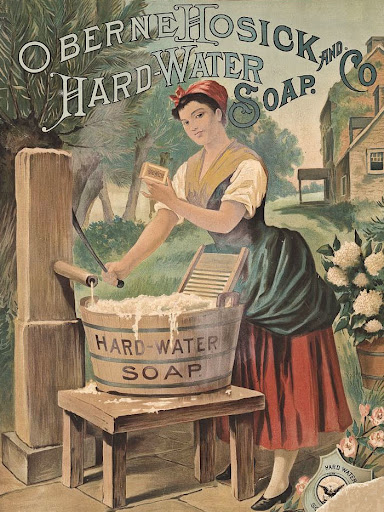
Taking you back in time, imagine life without any technology whatsoever. You don’t have electric or gas stoves, but wood burning stoves instead, you don’t have computers to write your family and friends an email or the ability to share photos, but you have to hand write everything down to the last letter, there was no such thing as a washer and dryer, you had to use an old washboard for every article of clothing you wore. Which by the way, had to be taken to the nearest lake or creek to be washed and you can just forget your handy dryer with your lavender scented fabric softener sheets! And what…no FaceBook? My husband’s grandmother, Evelyn is still in awe, when I show her pictures on my iPhone and she doesn’t understand how they got there! I have tried many times to explain to her what FaceBook really is and how you can share photos of family and comment on them. My favorite part of this is the way she says, “You can do this on the computer? It does that? Oh, how nice!” (Laughing) Oh the possibilities! We haven’t even really started to break the mold as far as what technology can do for us today.

Image Source


So with this great thing called technology, I am searching and scouring the various websites and resources in search of my family. Making contact with relatives I never even knew I had, all through the use of the Internet and my laptop! Ha! Who knew?? But being out in the middle of the Pacific Ocean, living on Oahu, I find that I am forever grateful for the high tech world I live in, and being able to re-connect with family I haven’t seen since I was probably six years old! 


The digital world has turned my laptop into a great tool. I now have the power to see through the looking glass (my laptop screen) to the world that was once my ancestors, and see not only photos of them, but also see the homes where they lived, the town where they grew up, the ability to see historical maps as they were back in the 1700-1800’s, searching old newspapers and census records, and so on. 


Today, my research is at a standstill somewhat, as I am waiting to receive documents from a family member that will give me something solid and concrete as far as actual data and birth records. Having contacted several members of my family, who I might add, are gathering photos and documents for me as I type this article. I hope to read and go over these very soon!


Hopefully I will be able to tear down one or more of the brick walls that seem to have stopped me in my tracks. 


Happy Hunting!!

English: The Clan Sutherland Gatherin Stone In...

English: The Clan Sutherland Gatherin Stone Inscription on the stone “Ceann na Drochaide Bige”, meaning “The Head of the Little Bridge” This refers to the Clan Sutherland’s gathering place in Golspie, at which is the Gathering Stone. The inscription on the lower part reads in English, “The Chief of the Sutherlands Summons the Victorious Clan Sutherland to The Head of the Little Bridge”. There is also an old inscription on the top part that is in Gaelic. (Photo credit: Wikipedia)

As you may know by reading my past blog entries, I have been researching my Scottish ancestral lines beginning with the Sutherland surname. My ancestors were mainly from the Caithness and Edinburgh region (now called Midlothian, I think). Scottish names are as diverse and colorful as the country they represent. 


There is so much to write about when you think of Scotland. I could write about the culture, food or whiskey, or just the people and I would probably be typing out a blog post that may be uninteresting to some of you, as it would probably be closer to a book than a blog entry. There are many web sites that I could refer you to, just on Scotland’s Genealogy, but that would take all the fun out of searching and finding it yourself! 


In all truth, I haven’t completed much research this week and feel like I have neglected my poor blog page. I had been trying to post daily on a variety of different topics, but not this week. In today’s blog, I will be discussing some of the customs and traditions of my Scotland family. 


Scotland clothing mainly features the tartan (or plaid), which is the traditional dress of the people. Some mainlanders’ may think that a man wearing a “dress” is too feminine, therefore that makes the man wearing it, also more feminine. That is certainly not the case. It has more to do with tradition and their own culture than just flouncing around in a skirt all day, every day. The kilt is worn on special occasions much like our suit and tie events that we have in the United States. The Scots mostly wear these kilts to weddings and formal gatherings. 


Many years ago men wore one large sheet of tartan cloth over a long shirt. It was folded in such a way as to form the kilt shape as well as covering the torso and pinned at the shoulder. Have you seen the movie, Braveheart? The kilt was used as a blanket when sleeping outdoors and was easy to move around in. When formal armies were formed, a more robust garment was needed and the kilt as we know it was made.The kilt also represented their own Clan family. There were different kilts that were worn in battle a long time ago, but these were the more muted shades of the same tartan, almost like a camouflage I would imagine.